
Knowledge Base

Along
with the mega-trends of cloud computing proliferation, AI growth, and Network
cloudification, a broader range of emerging workloads exerts pressure on data
centers to expand their infrastructure scale. Based on internal requirements
and research motivation, a widely known research institute sought a solution to
overcome future possible infrastructure restrictions. They wanted to design a
flexible and extensible fundamental architecture that could improve production
efficiency without tearing down or building new data centers.
This research team found that different hardware configuration affects
the performance of applications. Therefore, they turned to the elasticity of
the composable system to cater to the application requirements in different AI
workload environments. According to their hypothetic concept, this design has
to support multiple tasks by drawing resources from a pool with processors,
accelerators, storage, and network devices. They went online to search for
possible partners to complete this project, and they found H3. Since 2014, H3
has already worked on PCIe switch technology for years. Therefore, this
well-known institute reached H3.
SOLUTION
Traditionally, a server is used to pair up with fixed accelerators and
memory. No matter how much the workload is, the server uses the same package to
process. Such an operation leads to over or under-provisioning. H3’s PCIe
switch technology realizes the avant-garde concept of pooling all the resources
in individual chassis at a rack level. Disaggregated devices can be dynamically
distributed to upstream compute servers through PCIe interconnects, effectively
tackling the resource waste problem.
Standing
on the solid experiences of PCIe switch technology development, H3 had a
breakthrough in connecting Broadcom PEX9797 switches to maximize the number of
lanes (288 PCIe 3.0 lanes) for device and host linkage. Such an infrastructure
design outperforms the traditional one by non-blocking sharing independent
accelerators, storage, and communications at a rack level. Users can arrange
the needed lanes optimally according to application bandwidth requirements. For
example, the research team found that in a specific fixed configuration
environment, due to the interconnect bandwidth saturation, the GPU performance
faces the bottleneck as the bandwidth saturates by its maximum of 16 GB/s
(Figure 1&2).

In other words, no matter how many GPUs got
installed, that hardware system can only offer the performance of about four
GPUs. Thanks to PCIe switch technology, the bandwidth can earn the opportunity
to be raised or reduced with dynamic lane arrangement instead of being locked.
The number of GPUs turns meaningful. As well, the resources become composable
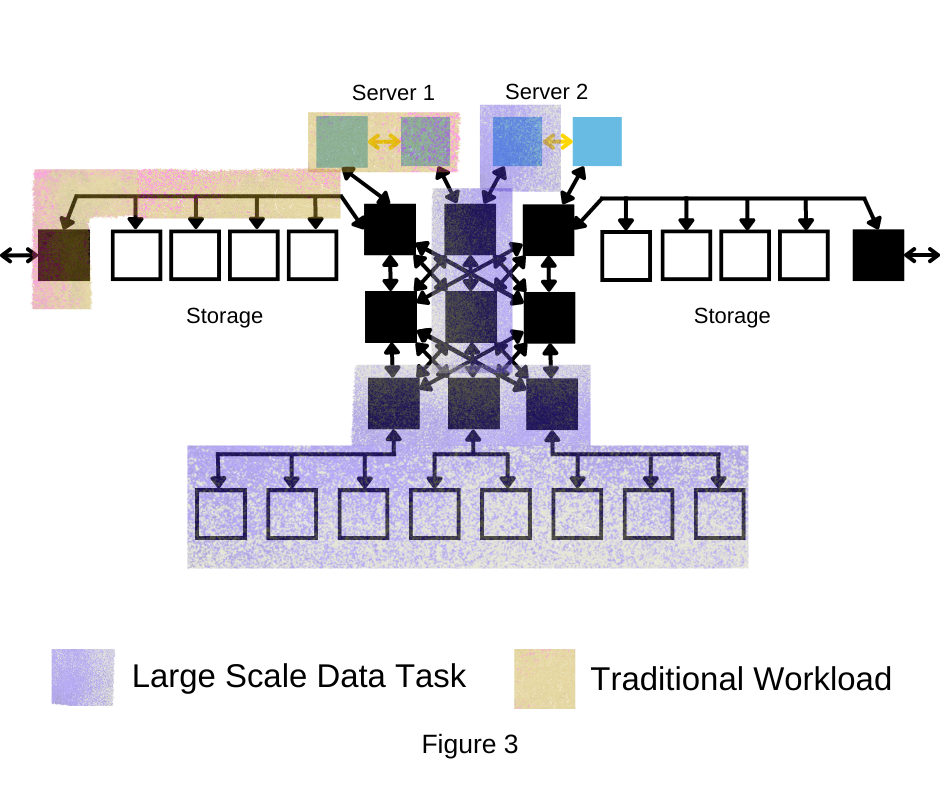
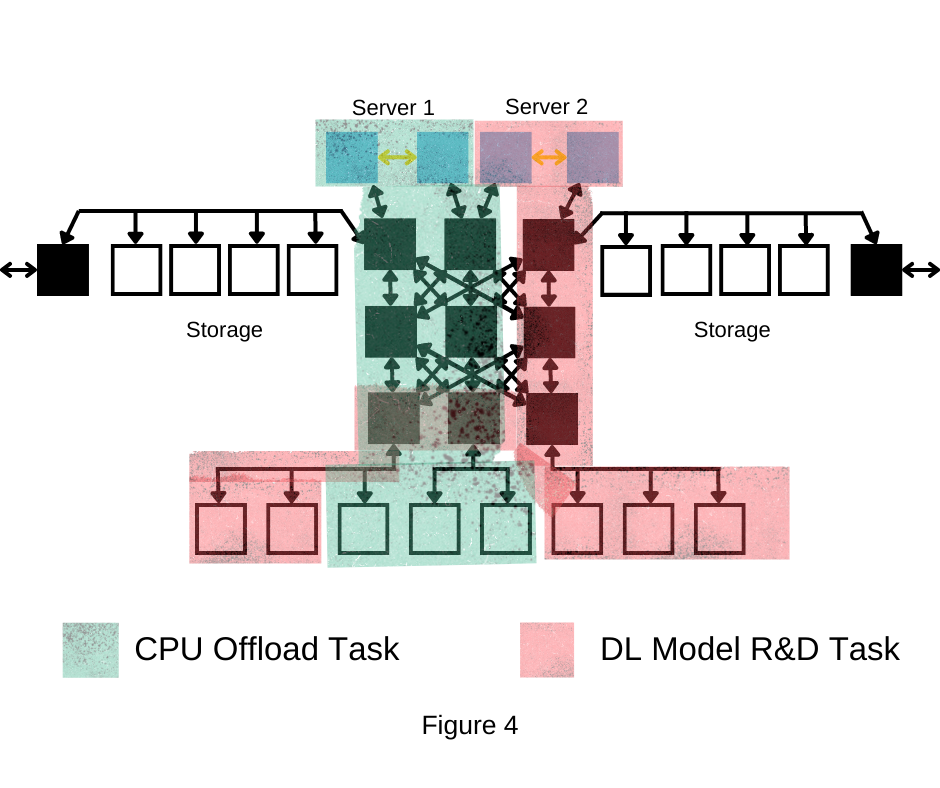
and arrangeable according to the tasks. For example, Figures 3 and 4 show
system can allocate different sets of accelerators to every server for their
specific workload, widely enhancing agility and flexibility.
RESULTS
According
to the research report, this research confirms that a composable system can
effectively buffer the influence of different component configurations on the
overall performance. One excerpt from their research paper that a researcher
can conduct AI workloads efficiently with the flexibility of the composable
system is a firm acknowledgment of our profession and hard work. Not only
having produced the valuable research paper, but this research team also
adopted composable solutions in their labs to run different AI workloads since
that time. This research team is still our customer, having purchased two
generations of PCIe composable systems and management solutions.


