
Knowledge Base
In
today's data-intensive application environment, the demand for high-performance
and scalable memory solutions has become crucial. To address the insufficient
DDR memory resources and performance limitations of traditional systems, H3
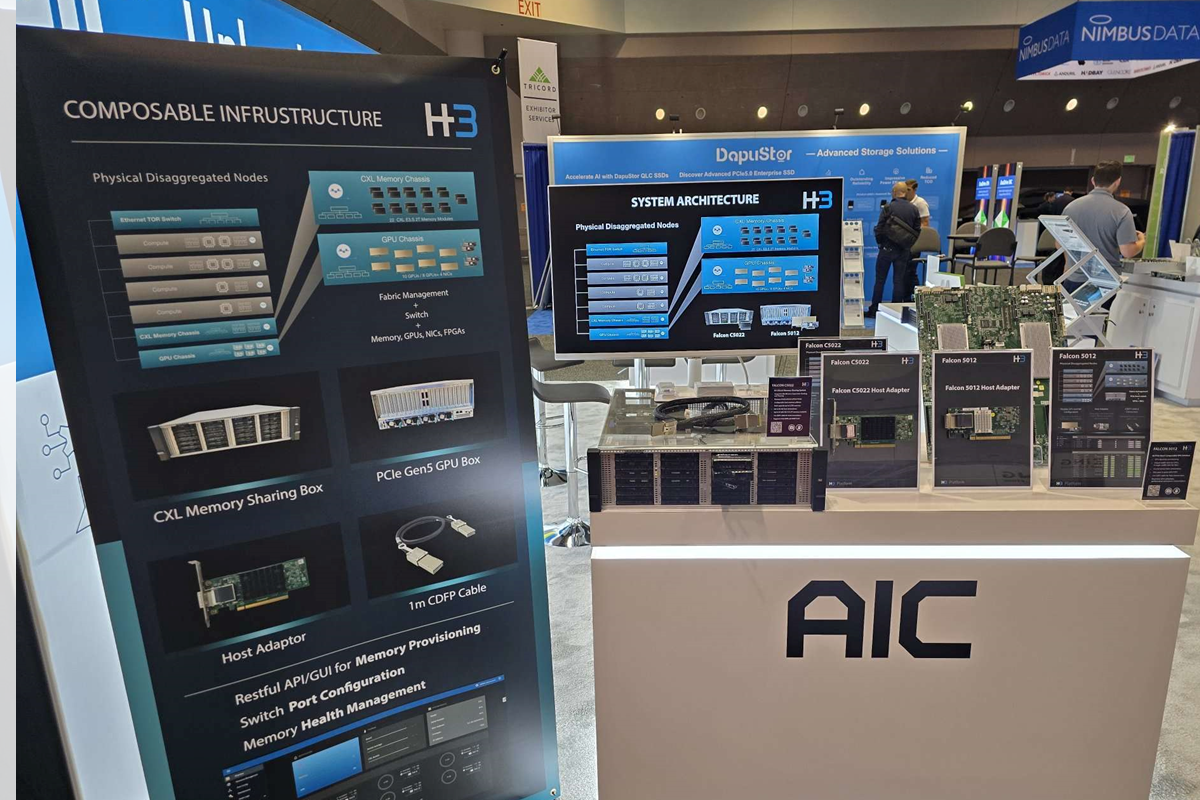
Platform has introduced the industry's first CXL 2.0 memory chassis, in
collaboration with Micron, showcased the FAMFS shared-memory file system at the
AIC booth during FMS 2024. This innovative memory-sharing solution is designed
to provide memory pooling and sharing capabilities for database, machine
learning, and artificial intelligence workloads.
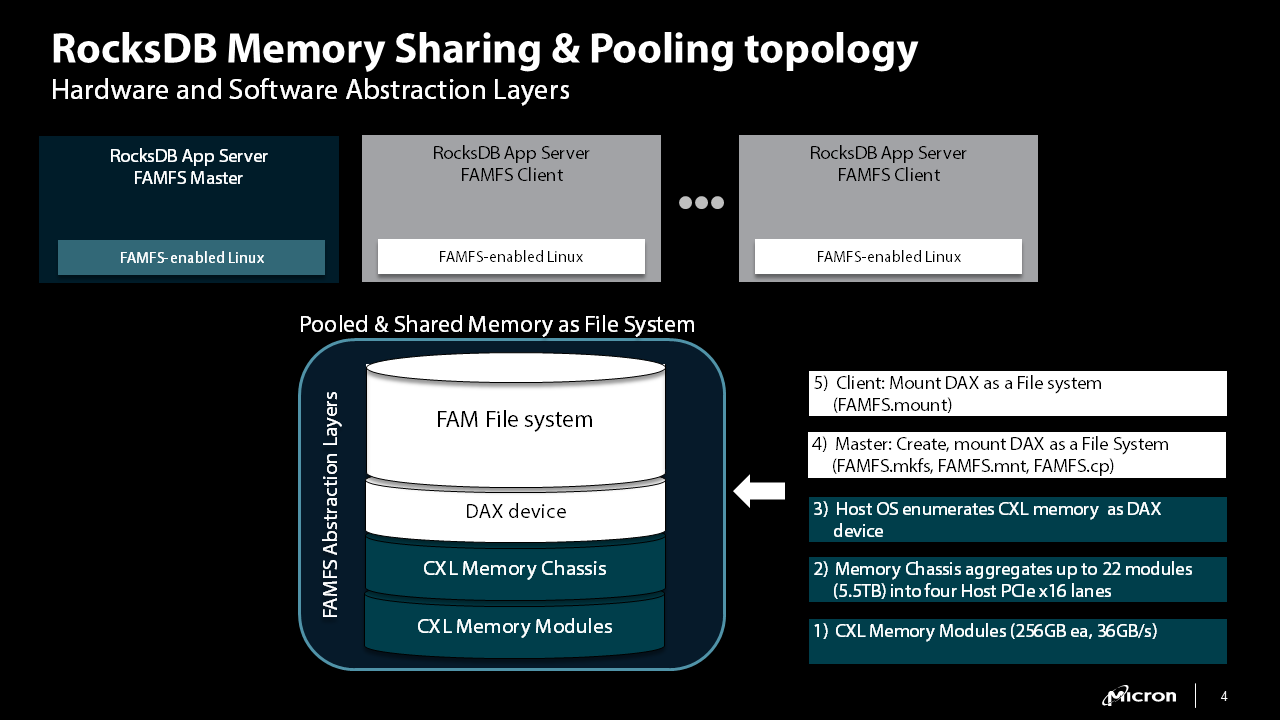
Our CXL Memory Sharing solution significantly enhances memory capacity, achieving up to 5.5TB of bandwidth per x16 PCIe lane through the disaggregation and sharing of memory resources. This breakthrough not only offers a 10x increase in memory capacity but also enables CXL memory to be directly exposed as a file system to applications without altering the existing application architecture.
In this setup, CXL memory modules are aggregated into a CXL Memory Chassis, supporting up to 22 E3.S modules with a total capacity of 5.5TB. These modules are connected to 4 hosts via PCIe Gen5 x16 lanes.
On
the host side, the FAMFS file system mounts these CXL memory modules as DAX
devices, allowing applications like RocksDB and other in-memory databases to
perform read and write operations directly on CXL memory modules. RocksDB can
seamlessly utilize these DAX devices and run the file system on them without
any modifications, demonstrating compatibility between CXL memory and RocksDB.
Moreover, the seamless integration of Linux/KVM with FAMFS further enhances the
application of CXL memory in RocksDB, making this integrated solution highly
effective for modern data-intensive workloads.
The
provided benchmark chart clearly illustrates the performance of RocksDB under
different storage solutions, particularly comparing the performance differences
between using XFS-SSD and shared CXL RAM (FAMFS) in random read operations.
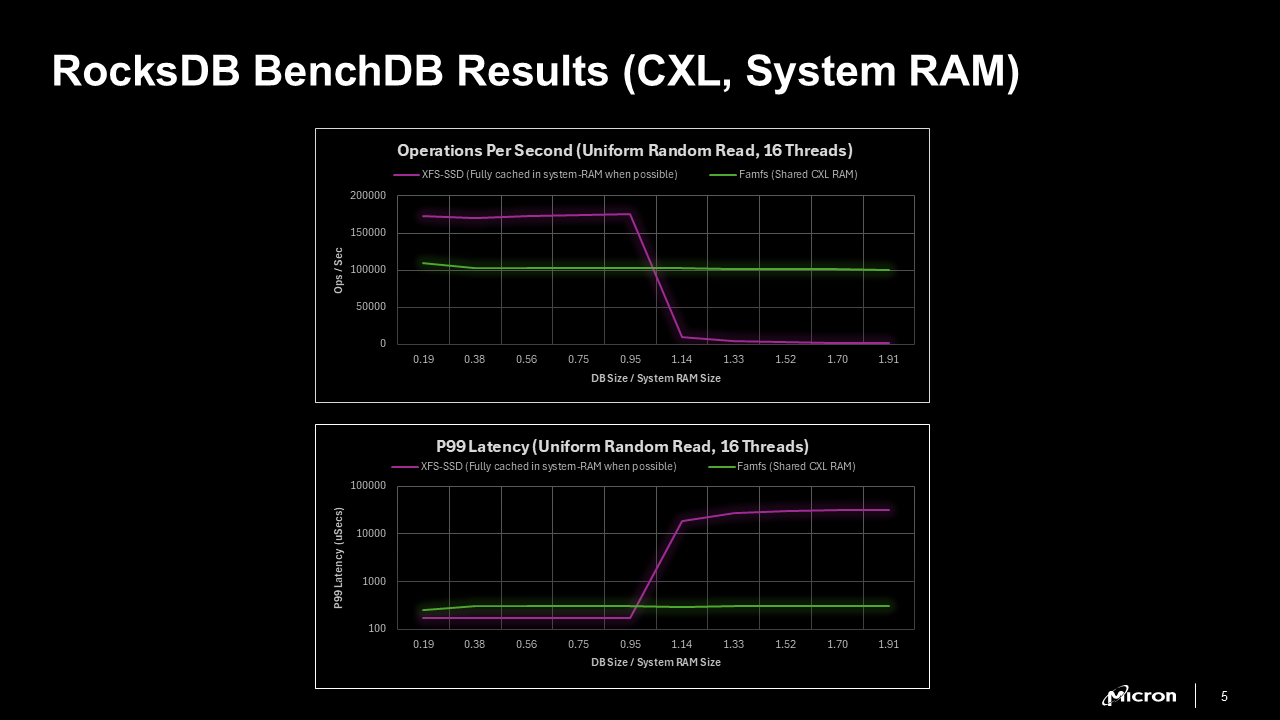
Operations Per Second (Ops/Sec): The upper chart shows the number of operations per second in random read operations as the database size approaches and exceeds the system RAM capacity. When using XFS-SSD fully cached in system RAM, performance drops sharply as the database size surpasses the system RAM capacity, reducing operations from nearly 200,000 to almost zero. In contrast, the FAMFS solution using shared CXL RAM maintains stable performance even when the database size exceeds the system RAM capacity.
P99 Latency: The lower chart shows the P99 latency trends in random read operations. When using XFS-SSD fully cached in system RAM, latency increases dramatically as the database size surpasses the system RAM capacity, rising from hundreds of microseconds to tens of thousands. In contrast, the FAMFS solution using shared CXL RAM maintains low latency even when the database size exceeds the system RAM capacity, demonstrating exceptional performance stability.
These
benchmark results highlight the advantages of combining CXL memory
chassis with FAMFS in handling RocksDB workloads. Compared to traditional
XFS-SSD solutions, the FAMFS solution using shared CXL RAM can maintain stable
operational performance and low latency even when the database exceeds system
RAM capacity, making it an ideal choice for data-intensive applications.
These results not only demonstrate the system's flexibility and stability under different data loads but also underscore the potential and practical value of CXL technology in enhancing database application performance. For application scenarios requiring high performance under heavy load conditions, the combination of CXL memory chassis and FAMFS is undoubtedly a great solution.
Integrating CXL chassis and FAMFS enhances performance and delivers
significant total cost of ownership (TCO) benefits. By freeing up system RAM
originally allocated for RocksDB execution, system resources can be utilized
more efficiently for broader general-purpose computing. Additionally, RocksDB
data in CXL memory can be shared and pooled across other RocksDB nodes or
virtual machines, further increasing system flexibility. The higher CXL
capacity also reduces data transfers across storage networks, thereby lowering
system power consumption.
This
solution is also applicable to various other data-intensive applications such
as Apache Arrow, Jupyter, NumPy, Pandas, Dask, PyTorch, DuckDB, Apache Spark,
Ray, Velox, and more, fully demonstrating its potential in high-performance
computing and data processing scenarios.
The joint solution by H3 Platform and Micron, through introducing the CXL 2.0 memory chassis and FAMFS file system, has successfully addressed the insufficient DDR memory resources and performance challenges faced by traditional systems in data-intensive applications. This innovative technology significantly enhances memory capacity and performance while achieving compatibility with existing applications through simple integration. Particularly in handling workloads such as RocksDB in in-memory databases, the combination of CXL memory and FAMFS showcases exceptional performance and stability, making it an indispensable solution for future data-intensive applications.


