Part of the Technology photoes in this website are created by rawpixel.com - www.freepik.com

Which GPU Is The Best? RTX 5090, RTX PRO 6000 Blackwell, or RTX 4090?

4665

We’ve selected four of the most highly discussed NVIDIA GPUs in professional fields for this comparison: RTX 5090, RTX PRO 6000 Blackwell, RTX 4090, and RTX A6000 Ada. Among them, the RTX 3090 and RTX A6000 represent the previous generation built on the Ampere architecture, while the RTX 4090 and RTX 6000 Ada continue the legacy of the Ada Lovelace architecture. The latest entries, RTX 5090 and RTX PRO 6000, are powered by NVIDIA’s newest Blackwell architecture.


Through this comparison, we aim to help users understand which GPU is best suited to various application scenarios. Please note: all test results in this article are based on a single GPU, with no multi-GPU or cluster configurations involved.


Please be noted: Specifications and performance figures for RTX 5090 and RTX PRO 6000 Blackwell are based on current leaks, rumors, and projected benchmarks. Final specs may vary upon official release

 

一張包含螢螢幕擷取畫面、文字、行、字型的圖片 AI 所產生的內容可能不正確。

一張包含螢螢幕擷取畫面、文字、行、字型的圖片 AI 所產生的內容可能不正確。

GPU Specification Comparison Table


Why Are the CUDA Cores in the RTX 5090 So Important? — The Foundation of GPU Performance
Blackwell Architecture: A New Peak in Performance

Both the RTX 5090 and RTX PRO 6000 Blackwell adopt NVIDIA’s latest Blackwell architecture, built using TSMC’s 4nm process. While this is the same node as Ada Lovelace, Blackwell offers significant improvements in architectural design and core count.


The Blackwell GPUs drastically increase the number of CUDA cores and integrate fifth-generation Tensor Cores and fourth-generation RT Cores, resulting in a generational leap in performance for AI acceleration and ray tracing. CUDA cores are the fundamental units for parallel computation in GPUs. An increase in their number means the GPU can handle more concurrent tasks, which is critical for demanding workloads like AI model training, 3D rendering, and scientific simulations.


Which GPU is Better for Deep Learning: RTX Pro 6000 Blackwell vs RTX 5090?

In terms of deep learning, both the RTX Pro 6000 Blackwell and RTX 5090 are based on NVIDIA's latest Blackwell architecture, and they each target different segments of the AI development landscape. The RTX Pro 6000 Blackwell is equipped with a massive 96GB of GDDR7 memory and ECC support, making it highly suitable for training large-scale language models and running long-duration inference jobs. On the other hand, the RTX 5090, while also powerful, is more consumer-oriented, offering around 32GB of GDDR7 and no ECC, which may limit its usage in mission-critical applications.

Based on early leaked benchmarks and projects, the RTX 5090 is expected to deliver impressive raw performance, the RTX 5090 delivers impressive raw performance, even surpassing the RTX 4090 in many inference workloads. Its compute power makes it a great choice for developers who want high speed at a much more accessible price point. However, the RTX Pro 6000 is built for professional environments, offering not just more memory but also greater stability, ECC reliability, and certification for workstation use. 

Another major consideration is cost. The RTX Pro 6000 Blackwell is expected to be priced above $11,000, which is more than five times the projected price of the RTX 5090. That price difference may only be justifiable for users who require the extended memory capacity and ECC capabilities for enterprise-scale training or multi-modal AI workloads.


Ultimately, both GPUs are extremely capable for deep learning. The right choice comes down to your specific workload: whether you prioritize raw power and value (RTX 5090), or memory capacity and reliability (RTX Pro 6000 Blackwell). As of now, many details about the RTX 5090 and RTX PRO 6000 remain unconfirmed by NVIDIA. Readers should treat the information as speculative until official sources are available.


RTX Pro 6000 vs RTX 5090 vs RTX 4090: Professional Workloads and Real-World Benchmarks
Let us take a look at how the latest GPUs from NVIDIA perform under professional workloads. All three cards—RTX Pro 6000, RTX 5090, and RTX 4090—support hardware-accelerated ray tracing and are built on high-performance silicon. However, the difference lies in their architecture, power headroom, and rendering efficiency.

Both the RTX Pro 6000 and RTX 5090 are based on the new Blackwell architecture, featuring fourth-generation RT cores with full support for advanced techniques like Opacity Micro Maps (OMM) and Displaced Micro-Mesh (DMM). These improvements help reduce memory usage and dramatically accelerate real-time path tracing. Meanwhile, the RTX 4090, while still powerful, is based on the previous Ada Lovelace architecture and lacks some of the low-level optimization present in Blackwell chips.

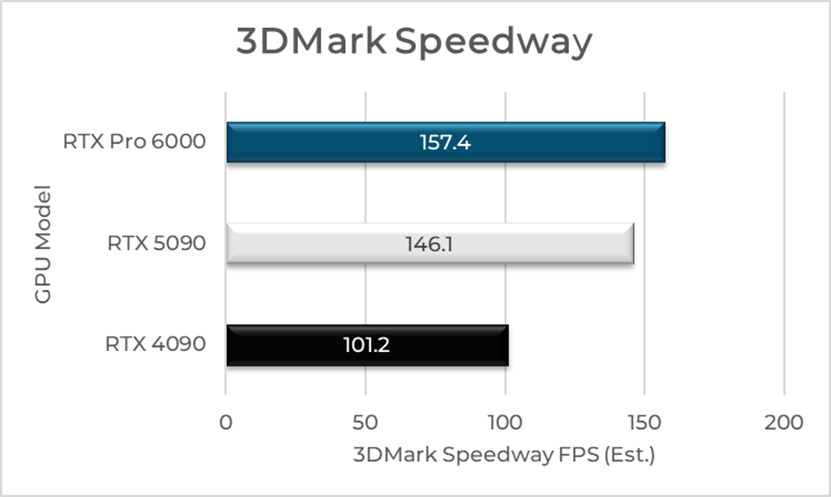
Preliminary 3DMark Speedway results shared by early testers suggest a performance gap. At full power (556W), the RTX Pro 6000 reaches 157.4 FPS, leading the pack. The RTX 5090 follows with 146.1 FPS at 551W, while the RTX 4090 trails behind at just 101.2 FPS on 408W.
                                                                  一張包含文字、螢幕截圖、數字、字型的圖片AI產生的內容可能不正確。

Bar Chart of Power Efficiency – 3DMark (FPS/Watt)(Source: der8auer, "Screw your RTX 5090 – This $10,000 Card Is the New Gaming King", YouTube, June 2025)


These differences may seem incremental between the top two cards, but they become significant in rendering pipelines where every second of compute time matters. The Pro 6000 also demonstrates better scaling under reduced power targets, offering 146.5 FPS at 75% power (449W), and still surpassing the 4090 even when capped at just 300W.

We can say that the RTX 4090 is now clearly a generation behind, and while it remains a popular choice for creators and developers, both Blackwell GPUs outperform it by a wide margin. The Pro 6000 pushes performance even further, particularly in environments that benefit from ECC memory, high VRAM, and workstation-class thermal tolerance.


RTX Pro 6000 vs RTX 5090 vs RTX 4090: Gaming Performance Compared
 A new benchmark test using Cyberpunk 2077 at 4K Max settings (no Ray Tracing, no Path Tracing) reveals even more about the gaming potential of these GPUs. The test system was built on an ASUS Crosshair X870E Hero motherboard with a Ryzen 9950X3D processor and 32GB of DDR5-6000 memory on Windows 11 24H2.

In this setup:
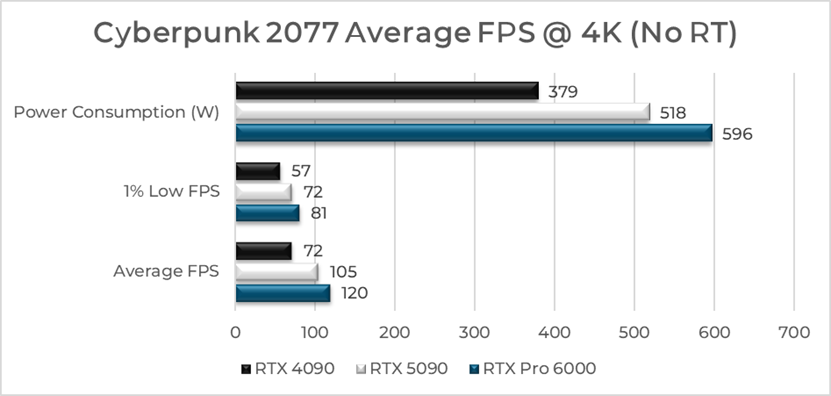
RTX Pro 6000 achieved an average of 120 FPS, with a 1% low of 81 FPS, and consumed 596W. RTX 5090 delivered 105 FPS on average, with a 1% low of 72 FPS, drawing 518W. RTX 4090 managed 72 FPS average, 1% low of 57 FPS, at 379W power consumption.

一張包含文字、螢幕截圖、數字、軟體的圖片AI產生的內容可能不正確。 

Bar Chart of Cyberpunk 2077 Average FPS @ 4K (No RT)(Source: der8auer, "Screw your RTX 5090 – This $10,000 Card Is the New Gaming King", YouTube, June 2025)

These results highlight the raw gaming performance advantage of the RTX Pro 6000, especially in heavy workloads like Cyberpunk 2077. While its power consumption is high, it leads across all performance metrics. The RTX 5090 balances strong performance with slightly better efficiency. Meanwhile, the RTX 4090 lags behind both newer Blackwell cards, showing its generational gap.

Benchmark results retrieved from independent reviewers such as Der8auer and sourced from Star Wars Outlaws (4K Max) and 3DMark test data (der8auer, 2025).

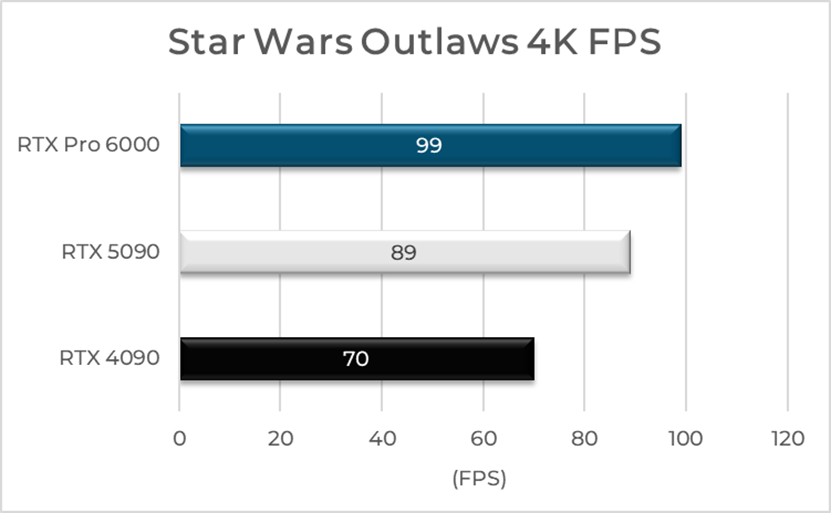
The charts clearly show that the new Blackwell architecture delivers a noticeable improvement in gaming workloads. In titles like Star Wars Outlaws, the RTX Pro 6000 achieves up to 99 FPS, outpacing both the RTX 5090 at 89 FPS and the previous-gen RTX 4090 at 70 FPS.
一張包含文字、螢幕捕捉畫面、數字、繪圖的圖片 AI 產生的內容可能不正確。

Bar Chart of Star Wars Outlaws 4K FPS (Source: der8auer, "Screw your RTX 5090 – This $10,000 Card Is the New Gaming King", YouTube, June 2025)


Likewise, in synthetic benchmarks like 3DMark Speedway, the Pro 6000 leads again, pushing up to 157.4 FPS, followed closely by the RTX 5090 at 146.1 FPS, and the 4090 significantly lower at 101.2 FPS.

Despite being marketed as a professional GPU, the RTX Pro 6000 surprisingly excels in gaming performance. However, its 600W+ power consumption and server-class thermal profile make it impractical for most gamers. The card is large, hot, and expensive—coming in at around $11,000. While it delivers extreme performance, it’s clearly overkill for gaming.

On the other hand, the RTX 5090 offers a far more balanced solution. It nearly matches the Pro 6000 in gaming frame rates while drawing slightly less power (~550W). Most importantly, it’s priced at a much more accessible $1,999, making it the likely go-to option for gamers who want top-tier performance without entering the workstation GPU territory.
 

As expected, the RTX 4090 still holds strong in the consumer gaming segment but is now visibly outclassed by its newer Blackwell counterparts. With just 24GB of GDDR6X and a power draw of 450W, it's more efficient but not competitive with the latest flagship cards in raw FPS.

Disclaimer: This article includes speculative content based on pre-release information and projected benchmarks. Actual performance and specifications may differ once the products are officially launched


Reference:

der8auer. (2025, June 1st). Screw your RTX 5090 – This $10,000 Card Is the New Gaming King [Video]. YouTube.
https://www.youtube.com/watch?v=o21CDqlCSps

Williams, W. (2024, March 14). Details of Nvidia’s fastest video card ever leak: RTX Pro 6000 Blackwell GPU will have 96GB GDDR7 ECC memory. TechRadar. https://www.techradar.com/pro/details-of-nvidias-fastest-video-card-ever-leak-rtx-pro-6000-blackwell-gpu-will-have-96gb-gddr7-ecc-memory


category : GPU
tags :
修正document.querySelector('link[rel="canonical"]').href = url_now; setCanonical('https://www.h3platform.com/blog-detail/' + reserved_para); } if (blogNum == "0") { if (para_id == "26") { setTD("NVMe MR-IOV - Lower TCO of IT System|H3 Platform", " Falcon 5208 NVMe MR-IOV solution ensures SSD performance and flexibility,. With built-in PCIe fabric, it requires less hardware to achieve high-performance storage service in comparison to other NVMe-oF solutions. An MR-IOV solution also allows better utilization of expensive CPUs especially in virtual environments."); } else if (para_id == "29") { setTD("【CXL Storage】 CXL 2.0 / PCIe Gen 5 - The Future of Composable Infrastructure|H3 Platform", "H3 Platform has NVMe MR-IOV solution, increasing storage utilization. SR-IOV of the NVMe SSDs is enabled in the NVMe chassis. CXL device are general-purpose accelerators such as NIC and GPU. CXL specification is based on PCIe Gen 5, and CXL allows CPU to access shared memory on accelerator devices. Nowadays, CXL 2.0 introduces pooling capability to the CXL protocol, improving the composability of memory."); } else if (para_id == "30") { setTD("【PCIe Expansion Chassis】– Big Accelerator Memory-Enhancing GPU and Storage Efficiency with PCIe Expansion Solution|H3 Platform", "Nvidia recently released a report on the effectiveness of Big Accelerator Memory (BaM) architecture. BaM leverages GPUDirect RDMA, allowing GPU thread to communicate with SSDs using NVMe queues to ultimately reduce reliance on CPU."); } else if (para_id == "36") { setTD("【CXL memory expansion】– Memory Expansion for Breakthrough Performance|H3 Platform", "CXL memory have been widely discussed for its capability to enhance memory bandwidth and capacity, and these benefits are significant to the emerging AI/ML applications. "); } else if (para_id == "40") { setTD("Toward PCIe Gen 5 Composable Infrastructure as a Service|H3 Platform", "The two case examples above indicate H3's capability to realize device pooling potential and expand resource configuration flexibility. That might be why SC 22 invites H3 to share experiences in the panel session. H3 is ready for everything @SC22. We look forward to displaying H3's avant-garde PCIe Gen 5 CIaaS worldwide."); } else { setTD(strT); } setInternalLink(document.querySelector("div.editor-content"), { href: "/product-list/10", anchor: array_gpuchassis[urlID % array_gpuchassis.length] }, { href: "/product", anchor: array_product[urlID % array_product.length] }); setArticleSchema(); document.querySelectorAll("ul.breadcrumb a")[1].href = "https://www.h3platform.com/blog-list?category=10"; document.querySelectorAll("ul.breadcrumb a")[2].innerHTML = document.querySelector(".title-container h1").innerText; document.querySelectorAll("ul.breadcrumb a")[2].href = url_now; document.querySelectorAll("ul.breadcrumb a")[2].style.color = "#808285"; } else if (blogNum == "1") { if (para_id == "24") { setTD("Increase the Efficiency of Storage System with Multi-host NVMe SR-IOV solution|H3 Platform", "NVMe SR-IOV is the solution for NVMe SSD sharing the resource among multiple servers often limits SSD’s performance as the networking creates I/O bottleneck."); } else if (para_id == "25") { setTD("NVMe MR-IOV – High-Performance Storage Solution for Virtual Environment Deployments|H3 Platform", "Multi-host NVMe SR-IOV, or multi-root SR-IOV (MR-IOV) is the solution aims to improve SSD performance under virtual environments while ensuring high utilization and flexibility for the storage resources. H3 Platform's proposed MR-IOV solution extends the application of SR-IOV."); } else if (para_id == "50") { setTD("【PCIe Gen 5 NVMe chassis】PCIe Gen 5 NVMe MRIOV Solution for Storage Scalability|H3 Platform", "NVMe, a new generation of high-speed storage interface, has higher bandwidth and lower latency than the traditional SATA interface. NVMe Multi-Root IO Virtualization technology (NVMe MR-IOV) further scales up the NVMe resources to realize mass storage sharing and virtualization by allowing multiple virtual machines to visit the same pool of NVMe devices at the same time."); } else { setTD(strT); } setInternalLink(document.querySelector("div.editor-content"), { href: "/product-list/17", anchor: "NVMe MR-IOV Solution" }, { href: "/product", anchor: "Composable NVMe SSD" }); setArticleSchema(); document.querySelectorAll("ul.breadcrumb a")[1].href = "https://www.h3platform.com/blog-list?category=11"; document.querySelectorAll("ul.breadcrumb a")[2].innerHTML = document.querySelector(".title-container h1").innerText; document.querySelectorAll("ul.breadcrumb a")[2].href = url_now; document.querySelectorAll("ul.breadcrumb a")[2].style.color = "#808285"; } else if (blogNum == "2") { setTD(strT); setInternalLink(document.querySelector("div.editor-content"), { href: "/product-list/17", anchor: "NVMe MR-IOV Solution" }, { href: "/product", anchor: "Composable NVMe SSD" }); setArticleSchema(); document.querySelectorAll("ul.breadcrumb a")[1].href = "https://www.h3platform.com/blog-list?category=12"; document.querySelectorAll("ul.breadcrumb a")[2].innerHTML = document.querySelector(".title-container h1").innerText; document.querySelectorAll("ul.breadcrumb a")[2].href = url_now; document.querySelectorAll("ul.breadcrumb a")[2].style.color = "#808285"; } else if (blogNum == "3") { if (para_id == "73") { setTD("Composable Memory System: 210M IOPS, Reduce Bottlenecks|H3 Platform", "Composable memory systems deliver up to 210 million IOPS and remove memory bottlenecks using CXL. Features include dynamic memory pooling, real-time allocation, and improved resource use—helping data centers scale faster while reducing TCO."); } else if (para_id == "72") { setTD("CXL 2.0 Memory Pooling Breakthrough|Four Servers Sharing 2TB Achieve 210M IOPS and 120GB/s Bandwidth|H3 Platform", "Discover H3 Platform's latest advancement in CXL 2.0 memory pooling and memory sharing technology, enabling four servers to share 2TB of memory. Key highlights include achieving 210 million IOPS and 120GB/s bandwidth, significantly enhancing data access speeds and system performance. Explore the detailed test environment, methodologies, and results that showcase this innovative leap in server memory management."); } else if (para_id == "68") { setTD("What is CXL Memory Sharing? Unlocking Shared Memory for AI and HPC|H3 Platform", "Learn how CXL memory sharing is revolutionizing computing with enhanced scalability and efficiency. This blog dives into CXL shared memory, its applications in AI and HPC, and how it transforms disaggregated memory architecture. Explore CXL technologies, protocols, and their role in creating resilient memory management systems for distributed environments. Discover why CXL memory is the future of high-performance computing and data processing."); document.querySelector("main#blog-content img.cover").alt = document.querySelector("div.title-container h1").textContent; } else { setTD(strT); } setInternalLink(document.querySelector("div.editor-content"), { href: "/product-list/18", anchor: "CXL Memory Pooling Solution" }, { href: "/blog-detail/68", anchor: "CXL Memory Sharing Architecture" }); setArticleSchema(); document.querySelectorAll("ul.breadcrumb a")[1].href = "https://www.h3platform.com/blog-list?category=14"; document.querySelectorAll("ul.breadcrumb a")[2].innerHTML = document.querySelector(".title-container h1").innerText; document.querySelectorAll("ul.breadcrumb a")[2].href = url_now; document.querySelectorAll("ul.breadcrumb a")[2].style.color = "#808285"; } else if (blogNum == "4") { // 2025-1208 setTD(strT); /* setInternalLink(document.querySelector("div.editor-content"), { href: "/blog-detail/77", anchor: "AI Storage Fundamentals" }); */ setArticleSchema(); document.querySelectorAll("ul.breadcrumb a")[1].href = "https://www.h3platform.com/blog-list?category=15"; document.querySelectorAll("ul.breadcrumb a")[2].innerHTML = document.querySelector(".title-container h1").innerText; document.querySelectorAll("ul.breadcrumb a")[2].href = url_now; document.querySelectorAll("ul.breadcrumb a")[2].style.color = "#808285"; if (para_id == "77") { setFAQSchema(); } } var breads = [{ href: "/", anchor: "H3 Platform" }, { href: "/blog-list", anchor: "Blog" }, { href: url_now, anchor: document.querySelector(".title-container h1").innerText }]; setBreadCrumbSchema(breads); setSocialMediaMeta({ cond: "meta[property='og:title']", cont: strT }, { cond: "meta[property='og:url']", cont: url_now }, { cond: "meta[property='og:description']", cont: strD }); createTag("meta", { name: "thumbnail", content: document.querySelector("img.cover").src }); function checkData(obj) { for (var i = 0; i < obj.group.length; i++) { if (obj.group[i].blogID.includes(para_id)) { return i; } } } function setTD() { var metaTitle = document.querySelector("title"); var metaDes = document.querySelector("meta[name='description']"); if (arguments.length > 1) { if (!metaDes) { var des = document.createElement("meta"); des.name = "description"; document.getElementsByTagName("head")[0].appendChild(des); des.content = arguments[1]; } else { metaDes.content = arguments[1]; } metaTitle.innerHTML = arguments[0]; } else { metaTitle.innerHTML = arguments[0]; } } function createDetailContent(target, id, content) { var real_id = "jsContent" + id; target.innerHTML = '' + target.textContent + ''; var tag_article = document.createElement("article"); tag_article.style.display = "none"; tag_article.style.textAlign = "center"; tag_article.style.marginBottom = "1em"; tag_article.id = real_id; tag_article.innerHTML = content; target.parentNode.insertBefore(tag_article, target.nextElementSibling); } function show(id) { var t = document.querySelector("article#" + id); t.style.display = (t.style.display == "none") ? "" : "none"; } function addSchema(schema) { var scriptJSON = document.createElement("script"); scriptJSON.type = 'application/ld+json'; scriptJSON.innerHTML = JSON.stringify(schema); document.getElementsByTagName("head")[0].appendChild(scriptJSON); } function extend(obj, src) { for (var key in src) { if (src.hasOwnProperty(key)) obj[key] = src[key]; } } function setBreadCrumbSchema(breadContent) { var schemaData_bread = { "@context": "http://schema.org", "@type": "BreadcrumbList", "itemListElement": [] }; var itemListElement = []; for (var i = 0; i < breadContent.length; i++) { var item = { "@type": "ListItem", "position": i + 1, "item": { "@id": breadContent[i].href, "name": breadContent[i].anchor } }; itemListElement.push(item); } extend(schemaData_bread.itemListElement, itemListElement); addSchema(schemaData_bread); } function setSocialMediaMeta() { for (var i = 0; i < arguments.length; i++) { document.querySelector(arguments[i].cond).content = arguments[i].cont; } } function createTag(tagName) { var tag_head = document.getElementsByTagName("head")[0]; var tag = document.createElement(tagName); for (var i = 1; i < arguments.length; i++) { for (attr in arguments[i]) { tag.setAttribute(attr, arguments[i][attr]); } } tag_head.appendChild(tag); } function setInternalLink(target) { var tagDiv = document.createElement("div"); tagDiv.style.marginTop = "2.5em"; tagDiv.style.textAlign = "left"; tagDiv.style.color = "#231F20"; var strLink = ""; for (var i = 1; i < arguments.length; i++) { strLink += '' + arguments[i].anchor + '|'; } tagDiv.innerHTML = 'Product Info:' + strLink.substring(0, strLink.length - 1); target.appendChild(tagDiv); } function count_url(url) { var url_to_id = 0; for (var i = 0; i < url.length; i++) { url_to_id += url.charCodeAt(i); } return url_to_id; } function getParameter(name, url) { name = name.replace(/[\[\]]/g, "\\$&"); var regex = new RegExp("[?&]" + name + "(=([^&#]*)|&|#|$)"); var results = regex.exec(url); if (!results) { return null; } if (!results[2]) { return ' '; } return decodeURIComponent(results[2].replace(/\+/g, " ")); } function setCanonical(url_path){ var canonical_check = document.querySelector("link[rel=canonical]"); if(!canonical_check){ var link_seo = document.createElement("link"); link_seo.rel = "canonical"; link_seo.href = url_path; var head_place = document.getElementsByTagName("head")[0]; head_place.appendChild(link_seo); } else{ canonical_check.href = url_path; } } function setArticleSchema() { var imgElem = document.querySelector("div.editor-content img"); var imgUrl = imgElem ? imgElem.src : "https://www.h3platform.com/img/blog/blog-banner.jpg"; var timeText = document.querySelector("time").textContent.trim(); var PublishDate = formatDateToISO(timeText); var schemaData_Article = { "@context": "https://schema.org", "@type": "Article", "headline": document.querySelector(".title-container h1").innerText, "image": imgUrl, "datePublished": PublishDate, "author": { "@type": "Organization", "name": "H3 Platform", "url": "https://www.h3platform.com/about" }, "publisher": { "@type": "Organization", "name": "H3 Platform", "logo": { "@type": "ImageObject", "url": "https://www.h3platform.com/img/logo.png" } }, "description": document.querySelector("div.editor-content").innerText.substring(0, 300) + " ..." }; addSchema(schemaData_Article); } function formatDateToISO(timeText) { var dateObj = new Date(timeText); var yyyy = dateObj.getFullYear(); var mm = String(dateObj.getMonth() + 1).padStart(2, '0'); var dd = String(dateObj.getDate()).padStart(2, '0'); var fixedTime = "09:00:00"; var timezone = "+08:00"; return `${yyyy}-${mm}-${dd}T${fixedTime}${timezone}`; } function setFAQSchema() { var schemaData_FAQ = { "@context": "http://schema.org", "@type": "FAQPage", "mainEntity": [] }; var questionList = []; for (var i = 0; i < document.querySelectorAll(".FAQ_Schema_Q").length; i++) { var item = { "@type": "Question", "name": document.querySelectorAll(".FAQ_Schema_Q")[i].textContent.trim(), "acceptedAnswer": { "@type": "Answer", "text": document.querySelectorAll(".FAQ_Schema_A")[i].textContent.trim() } }; questionList.push(item); } extend(schemaData_FAQ.mainEntity, questionList); addSchema(schemaData_FAQ); }